Skip to content
Kroma homeEN
Kroma homeEN

The Way of the Cross in Sveti Petar u Šumi

A forest path of stone stations above one of Istria’s oldest monasteries. Modern, quiet forms carry one of the oldest stories in Christian art.

Sculpture · Stone
Sveti Petar u Šumi, Istria

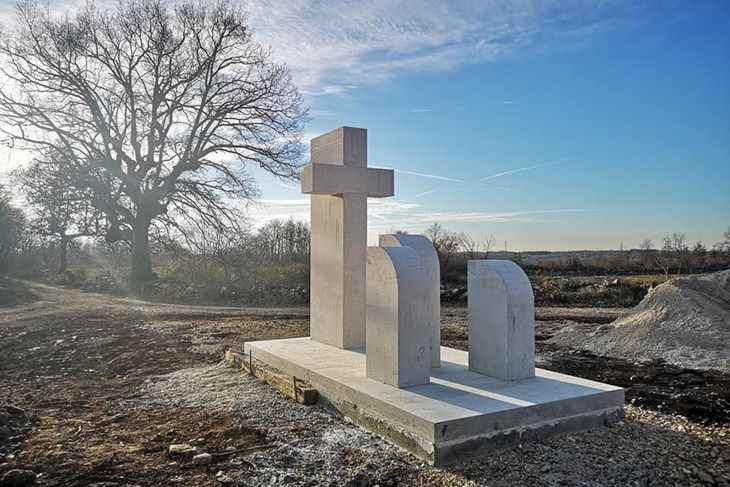
Stone cross and two curved stone slabs on a stone base under a blue sky

A village built around a monastery

Sveti Petar u Šumi, “St Peter in the Forest”, grew up around its monastery. The first community here was Benedictine. When it faded, Emperor Frederick III handed the abandoned site to the Paulines, the “white friars”, in 1459, and they rebuilt it.

The monastery was burned during the Uskok War in 1616 and rebuilt from the mid-17th century. Its church of Saints Peter and Paul was re-consecrated in 1755 behind a new Baroque facade, with an interior that is rare in Istria. A painting of Our Lady of Częstochowa on the main altar, said to have wept on Christmas Eve 1721, made the village a place of pilgrimage. The Paulines returned to the parish in 1993.

A Way of the Cross fits naturally into this landscape: a village that has drawn pilgrims for three centuries, surrounded by oak forest and old paths.

An old devotion

The Way of the Cross, Via Crucis or Križni put, follows Christ’s last walk from his sentencing to the tomb. It began with pilgrims in Jerusalem retracing the route on foot. Europeans who could not travel there built copies at home: chapels, carved stations and painted panels set along a path or around a church, so the walk could be made anywhere. Over time the number of stations settled at fourteen.

Here, the stations are told in stone alone, without figures.

Fallen stone cross on a stone slab, with stone benches and a cypress behind
Third station: Jesus falls for the first time.
Stone cross on a pillar with a leaning stone slab, beside an old oak
Sixth station: Veronica wipes the face of Jesus.

Stone, reduced to essentials

Each station is built from a few blocks of white stone: a cross, a slab, a plinth. There are no figures; the story is told by how the cross stands, leans or falls. A bronze Roman numeral and a small bronze plaque mark each station.

The smooth surfaces let the light do the work, and stone benches and cypresses make each station a place to stop.

Walking the path

The path is named after Father Danijel Hekić and begins at his birth house in the hamlet of Gljušćići. It winds for about 4.2 km through the woods and between old dry stone walls, in the shape of a rosary. Its fourteen stations are carved from monumental blocks of Istrian stone from the Kanfanar and Kirmenjak quarries, with stone benches for rest along the way. The path was blessed on 10 March 2019, the first Sunday of Lent.

It is easy to combine with a visit to the monastery church.

Visit the studio in Sveti Petar
u Šumi

alida.kroma@gmail.com
+385 91 571 3193